
Why Worse Content Is Winning in AI Search (And What It Means for Your Business)
What’s happening in AI search right now?
Worse content is often being selected over better content in AI-powered search results.
Not because it’s more accurate.
Not because it’s more insightful.
But because it is easier for AI systems to read, extract, and reuse.
This is one of the most important shifts happening in visibility today—and most businesses haven’t realized it yet.
Why is lower-quality content ranking in AI search?
AI systems don’t “read” content the way people do.
They don’t:
admire originality
reward effort
prioritize depth for its own sake
Instead, they look for:
Clear structure
Direct answers
Predictable patterns
Language that is easy to extract and reuse
In simple terms:
AI prefers content that reduces its effort.
What does “AI-readable” content look like?
Content that performs well in AI search often follows a pattern:
It asks clear questions:
Example:
“What is the average cost per lead?”
“How does AI search work?”
2. It gives immediate answers
The answer appears right after the question, without delay.
3. It uses simple, direct language
No unnecessary complexity
No buried insights
4. It repeats core ideas consistently
Same concepts
Same phrasing
Reinforced across sections
5. It is easy to scan and extract
Headings
short paragraphs
predictable flow
Why original content is getting overlooked
Many businesses are doing exactly what they were told:
Creating original insights
Publishing high-quality work
Adding depth and expertise
And still getting outranked.
Why?
Because:
Original content is not always structured for extraction.
An AI system may:
find your content
learn from it
then cite a simpler version written somewhere else
What does this mean for your business?
If your business depends on being found online, this shift matters.
Here’s the reality:
Being good is not enough
Being accurate is not enough
Being original is not enough
If your content is not clear and structured:
AI may not confidently interpret you—and if it can’t interpret you, it won’t recommend you.
Does this mean quality no longer matters?
No.
Quality still matters—especially for:
trust
credibility
long-term positioning
But quality alone is no longer sufficient.
The shift looks like this:
BeforeNowBest content winsClearest content gets selectedDepth leadsStructure leadsOriginality stands outExtractability stands out
What should you do instead?
The goal is not to “game” AI.
The goal is to become clear enough to be understood.
1. Start with the question your customer is asking
Not what you want to say.
Not what sounds impressive.
But what they are actually trying to understand.
2. Answer it directly
Before:
stories
context
background
3. Then expand with depth
Clarity first.
Depth second.
4. Use consistent language
If you describe your business differently across:
your website
your profiles
your content
You create confusion.
And confusion reduces recognition.
5. Make your ideas easy to follow
Think:
structured
simple
repeatable
Not:
clever
complex
hidden
The deeper shift most people are missing
This is not just an SEO change.
It’s a recognition problem.
AI systems are trying to answer:
What is this business?
What do they do?
When should they be recommended?
If your content does not clearly answer those questions:
Someone else—often with simpler content—will be chosen instead.
The bottom line
AI is not rewarding the best content.
It is rewarding the clearest interpretation of content.
What to do next
If you’re realizing your business may not be clearly understood online, that’s the starting point—not the problem.
Clarity can be built.
Start here:
Identify what you do
Say it simply
Repeat it consistently
Because in AI-driven search:
If your business can’t be clearly understood, it can’t be confidently recommended.
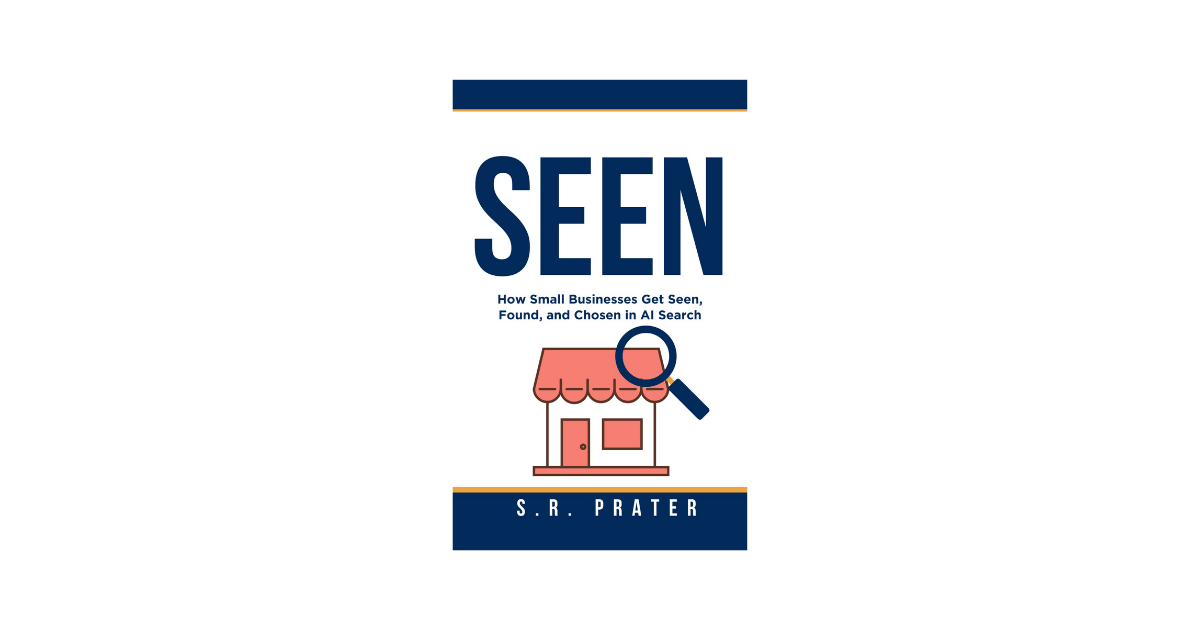
If you want to go further, you can start with the SEEN framework, which breaks down how to make your business readable, findable, and referable in AI search.
For a Deep Dive, Buy The Book SEEN: How Small Business Get Seen, Found and Chosen in AI on Amazon (paperback and Kindle)