
The Shift
If AI can’t understand your business, it can’t recommend it.
Something significant is happening in how people find businesses — and most small business owners haven't been told yet.
Google and YouTube just released their 2026 marketing guide, The Rise of the Super-Empowered Consumer, and the findings are striking. AI is collapsing the distance between curiosity and decision. What used to take hours of research, multiple tabs, and endless comparison is now happening in moments. According to the report, 77% of people using Google's AI search tools say they make decisions faster because of them — and 75% say they make more confident ones.
The research also reveals that the way people search has fundamentally changed. Queries in AI Mode are now three times longer than traditional searches, more conversational, more personal, and more intent-driven. People aren't typing keywords anymore. They're asking questions — and expecting clear, direct answers.
The result? Businesses are being chosen faster than ever before.
But only the ones AI can understand.
What This Means for You
Here's the translation no one is giving small business owners:
Businesses are no longer just discovered. They are interpreted.
Search engines — and the AI powering them — are no longer simply indexing your website. They are reading your content the way a thoughtful customer would, drawing conclusions about who you serve, what you solve, and whether you're the right fit. Then they're surfacing recommendations accordingly.
Google's report describes this as a move from information to intelligence — search that is "more intelligent, more personalized, and more agentic." That's not language for big brands with marketing departments. That's the new terrain every small business is operating in whether they know it or not.
This is the core of what I teach under the Soft Skills Win framework: clarity isn't a branding nicety. It's a competitive advantage. If the signal you're sending is muddy, inconsistent, or buried in language only insiders understand, AI won't amplify you. It will skip you.
The Problem (and You'll Recognize This)
You're good at what you do. Maybe excellent.
You've tried marketing. You've posted on social media, updated your website, maybe even run an ad or two. You've shown up — and still felt invisible.
But here's what no one told you: the problem isn't your effort. It's that the right systems can't read you clearly enough to recommend you.
Your potential customers are out there right now. According to Google's own data, 71% of shoppers arriving at Google Search are open to discovering a new brand or business. They're not locked in. They're looking. And somewhere in that process, your business isn't making the cut — not because you're not good enough, but because you haven't been interpreted correctly.
The New Rule
If AI can't understand you, it can't recommend you.
That's not a tech problem. It's a clarity problem.
AI doesn't reward the loudest business. It rewards the clearest one — the one whose message, audience, and value are expressed in plain, consistent, searchable language. The one that looks like an obvious answer to a specific question.
Google's report puts it plainly: search has evolved beyond matching keywords to "deeply understanding intent." The technology now recognizes why someone is searching, not just what they typed. That means your business needs to communicate clearly enough that both people and AI can immediately grasp what you do, who you serve, and why you're the right choice.
Clarity is the new currency.
The 3 Reasons You're Not Being Seen
After working with small businesses across industries, I see the same three gaps show up every time:
1. You're not clearly defined. You know what you do — but your online presence doesn't communicate it in a way AI can parse and customers can immediately grasp. Your niche, your audience, and your unique value are blurred.
2. You're not consistently expressed. Your website says one thing. Your social media says another. Your bio says something else entirely. Inconsistency signals confusion — to both people and algorithms. And Google is now tracking the full consumer journey across search, video, and content. Fragmentation costs you.
3. You're not easy to interpret. Even if your content is good, it may not be structured in a way that AI can extract meaning from quickly. No clear FAQs. No specific language. No signal that says "this business is the answer to this specific question." The Google report is explicit: the brands that earn recommendations are the ones that show up as the most helpful answer.
These aren't catastrophic failures. They're fixable gaps. But they have to be named before they can be addressed.
This Is Exactly What I Break Down in SEEN
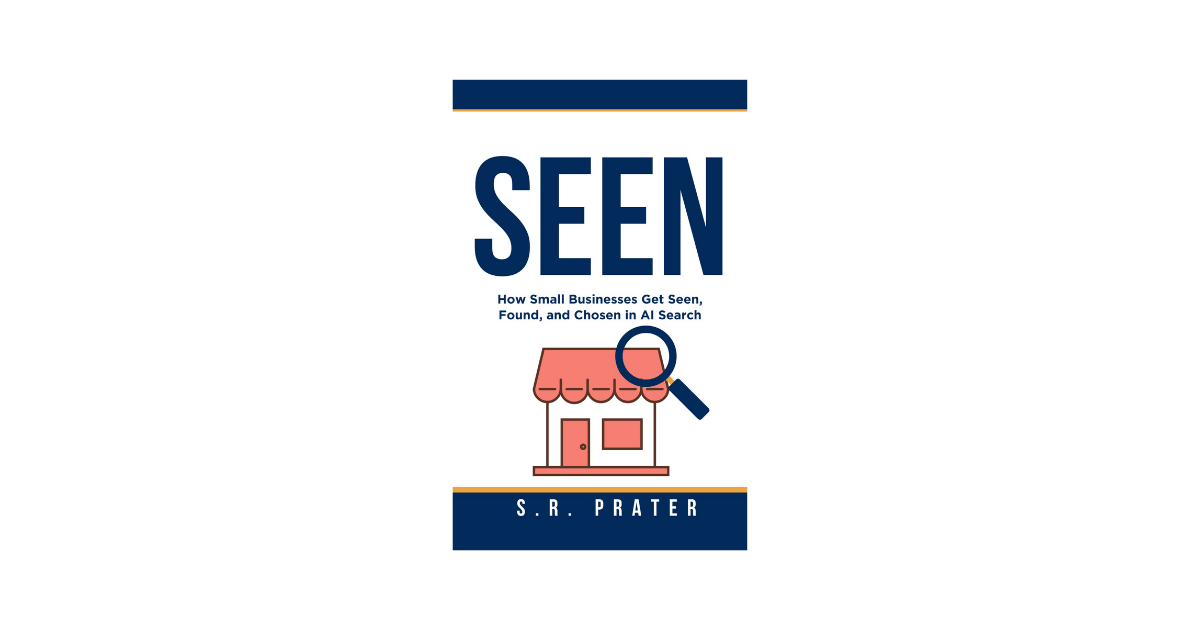
SEEN: How Small Businesses Get Seen, Found and Chosen in AI Search is the roadmap for closing these three gaps — without a marketing degree, a big budget, or a full-time content team.
It's written for the business owner who is already good at what they do, and who is ready to stop being the best-kept secret in their market.
Because visibility isn't luck. And it's not just about posting more. It's about making sure the right systems — and the right people — can finally read you clearly enough to choose you.
Start Here
Ready to find out where your business stands?
👉 Get the free AI Visibility Quickstart →Get AI Visible!
Is Your Business Visible to AI Search? Learn how to make it visible in a few easy steps!